Translate this page

Saturday, May 9, 2009

Wesak Day Celebration in Taiping

Wesak Day is celebrated by Buddhist throughout the world to commemorate the Birthday of Lord Buddha. It is an auspicious day in the Buddhist calendar, marking the full life cycle of birth, enlightenment and death of Buddha.

It is this day that Buddhist devotees will gather in temples to release birds from captivation and to offer prayers. Other practice includes the offering of alms to monks and giving of free meals to the needy, as symbolic acts of giving liberation and doing good deeds.
Celebration of Wesak as explained by the late Ven. Dr. K Sri Dhammananda holds a special significance for the millions of Buddhists who comprise a fifth of the world’s total population. In thousands of temples across the world from Tokyo in the East to San Francisco in the West, Buddhists will pay homage to an Indian Prince who forsakes the pleasures of a royal household to bring peace and happiness to mankind.

It is also most important to remember that this sacred day is purely and simply a religious festival and not a festive occasion for feasting, drinking and dancing. On this day all Buddhists are expected to reaffirm their faith in the Buddha Dhamma and to lead a noble religious life. It is a day for meditation and for radiating Loving-Kindness.

Saturday, May 2, 2009

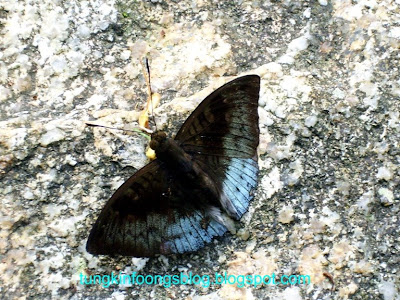
Malaysia’s Butterfly - Horsefield's Baron (Tanaecia iapis puseda)

I find it intriguing and interesting that butterflies like the Horsfield's Baron wing pattern can look so different in their male and female form but than, that is because they are dimorphic. Dimorphism is defined in Wikipedia as the systematic difference in form between individuals of different sex in the same species.

Female
In the case of the Horsefield’s Baron, the male has a black upper side with a blue border on
the hind wings while the female is greyish brown with luminous shadings of light bright blue. It is sometimes hard to tell the difference from another species especially for the female, as it looks almost similar to the Malay Viscount which has almost the same colors and markings on the wings.

Male

This species is quite common as I come across them quite often on bright sunny days, the males being the more often encountered ones.

Wednesday, April 22, 2009

Giant River Prawn ( Macrobrachium rosenbergii)

Also known as the giant freshwater prawn or the Malaysian prawn or more popularly called locally as Udang Galah is technically a species of freshwater shrimp and are not prawn but for this article we will refer to it as prawn for the sake of simplicity and not get ourselves further confused.

The “grow out” ponds in the farm.


The Males can grow sligthly bigger than females and can reach lengths of 12 inches and 10 inches respectively.
I have known that the giant fresh water prawn has been cultivated commercially since the late 1970’s but it is not until now that I have the opportunity to witness how it is done. And there it was, a commercial fresh water prawn farm located on the outskirt of town not too far from where I stay belonging to a friend of my brother- in-law.

Fresh water source is channel to the various ponds continuously through gravity feed without a need for an external power source.

In practice, it looks simple enough. A clean source of fresh water is required and is directed to flow continuously into what is called “grow out” ponds containing prawns that are at their various stages of growth based on time intervals. For example, pond no.1 is for prawns that are 2 months old and pond no.2 for prawns that are 4 months old and so forth and they are re-stocked accordingly to produce a cycle of continuous availability of prawns for harvesting.
2.5 months old prawns.


Getting and raising the prawn fry is another story, as they will need brackish water at the larval stage of development, it apparently goes through 11 larval stages to metamorphosis as post larvae taking between 16 to 35 days to do that and will not survive in fresh water at this stage. It is only after the larval stage of development when it progresses to juvenile stage that they will survive entirely on a fresh water environment. In this farm, only prawns that have outgrown the brackish water stage are stocked in the ponds.

4 to 5 months old prawn ready for harvesting.


Feeding the prawns seems to be an easy task as commercial feed is available and used. On the whole, I have the impression that the commercial farming of the Giant fresh water prawn is a matured industry and all the problems faced by it initially have been resolved. What is left to be done, is to find a good location with a good source of clean fresh water and one can take it from there........provided of course, you have the marketing contacts, resources and interest amongst other prerequisite.

Tuesday, April 14, 2009

Amorphophallus Prainii

I had previously written about this rare tuberous herbaceous plant from the Arum family and recently encounter them again as it appears to be quite common, at least around here.

In this particular encounter, I managed to spot four individual Amorphophallus Prainii plants growing wild with their flower blooming at different stages all located in rather close proximity of each other.
Technically, they are not flowers but are inflorescence (to us mortals, it means flowers on a stem), the spadix, which is the center apparatus have both the male and female components.

Before it turns into an inflorescence, the appearance is of a plant with leafs arising from a corm hidden beneath the soil. When the leaf finishes its growing cycle, the entire plant collapses and withers away and in some cases could remain dormant for a time. The next growing cycle is where the inflorescence appears but not always.
The photo below shows an Amorphophallus Prainii plant during its leafing cycle with the mottled looking bark right behind an inflorescence, note that they are both not connected and are individual plants.