

With a tight schedule planned for the 4 days I am there, I doubt I will see much of Shenzhen, if there is any opportunity to do so it would be in the late evenings.
The flight took slightly more than 4 hours arriving at almost 9 pm. It certainly helps that Malaysia shares the same time zone as China, without which I might need a while to get orientated.
The flight took slightly more than 4 hours arriving at almost 9 pm. It certainly helps that Malaysia shares the same time zone as China, without which I might need a while to get orientated.
 A blast of cold air hit my face as I step off the plane into Boa’an International Airport, it’s the beginning of colder weather in Shenzhen, what a pleasant change compared to hot and humid Kuala Lumpur a couple of hours ago. The winter here I am told by my Chinese office colleagues is very mild and at between 17 to 19 degrees celcius for the duration I was there it was rather comfortable.
Now let’s see the instructions from our Shenzhen office again, take only the red taxi not the green one and show the hotel address written in Chinese, travelling in Shenzhen is safe but pay attention to your belongings!
Me with the "Red" taxi in the background.

The advise sounds sensible for travelling in any part of the world. Shenzhen is a city of 153 sq miles populated by about 9 million industrious Han Chinese living and working together with 20% of China’s PhD holders, home to the world’s ninth tallest building and a city with a record of building one high rise a day and one boulevard every three.
Shopping district near the hotel.
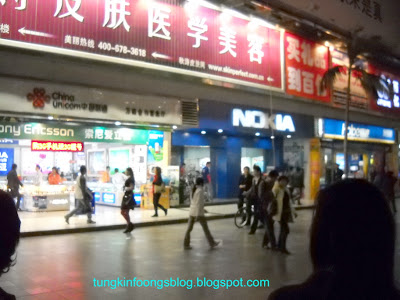
 True enough, all I had time for was to catch some sights of Shenzhen shopping district in one of the evening near the hotel, famous for it's cheap mobile phones on sale. Also had the opportunity to have a day trip to Dongguan on official duties.


 Meanwhile, the sheer density of people in the town here are overwhelming, you can literally feel the crowd everywhere. Traffic is haphazard but surprisingly I see many polite drivers here giving way when the need arise and with a smile too, never mind the other guy was travelling against traffic. Even more surprising was that I was able to see civilians and traffic policemen directing traffic together on the same spot of the road, most unusual and it doesn’t seem to cause any conflict.


 This fern can be found climbing and twirling around other plants forming into many smaller branches at times. The fern is endemic to Indo China, Peninsular Malaysia and Indonesia.
 From articles I read about this fern, the purpose for this unique exhibition of colors remains unclear. As a fern it produces no flowers, so the iridescent display by the fronds to functions as a mechanism to attract pollinators does not hold water. It has been speculated that this iridescent quality protects the fern from the ultraviolet rays of the sun which I believe many a botanist will disagree. Such is the work of nature that this iridescent leave fern are among the most striking of the world’s flora.
 The current explanation for this iridescent quality is best described by (David. W. Lee 1977)

 It is easily propagated by cutting off segments of old canes a few inches long and then allowed to dry. Once sufficiently dried they are inserted into moist sand until rooted and new growth will emerge from old leaf scars.
 The wild Dracaena fragrans has green leaves that can reach up to 3 feet long and 4 inches wide, often seen with a height that reaches almost 20 foot tall. However, once potted their size is stunted with slow growth and that is where I think its popularity as an indoor or house plant takes off.

 Other properties of Dracaena fragrans not widely known, includes the plant used in the NASA Clean Air Study that shows it can help remove Formaldehyde from the environment, indicating it would also make a good natural air scrubber for the home.


